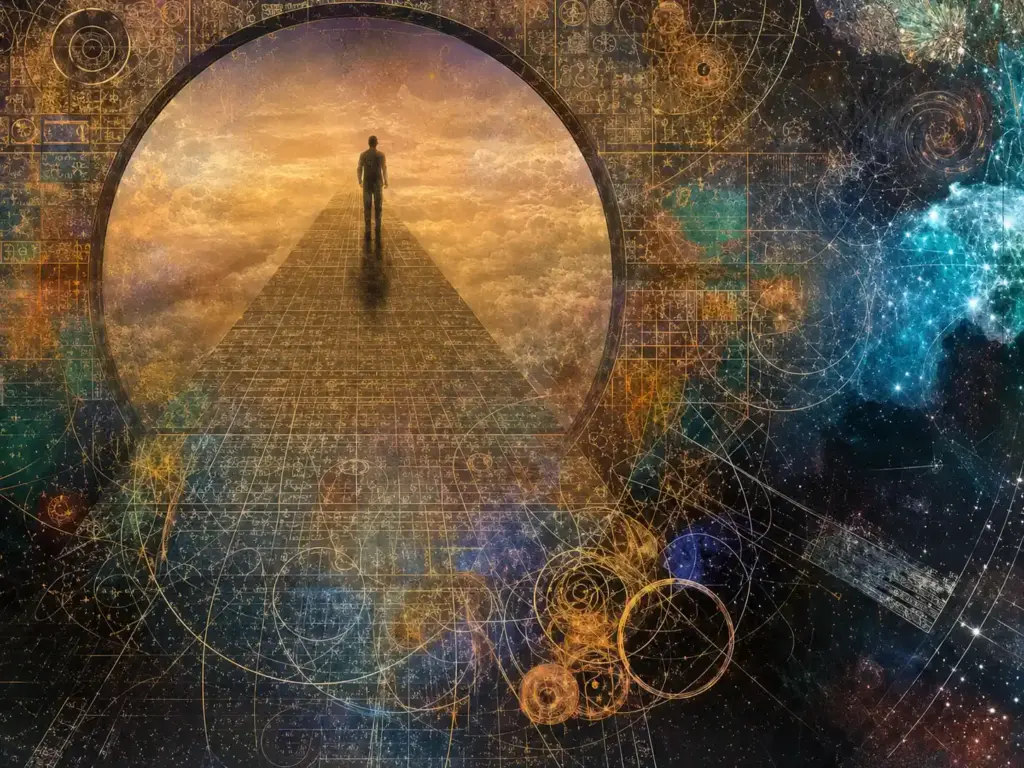



More than a choice, the contemporary challenge is to harmonize inner life and action in a fragmented world.
by Dulce Otero
Today, as soon as we wake up and connect with our surroundings, we are bombarded (many literally, unfortunately) with discouraging news about increasingly intense and lethal violence and wars.
Even in countries not directly involved in conflicts, the perception of violence is widespread as fueled by corruption scandals, unethical conduct by authorities, and environmental mismanagement that plunge us into growing skepticism about the future of humanity.
Taxi drivers, doctors, delivery workers, judges, businesspeople, domestic workers—all seem to share, to some degree, the same sense of moral exhaustion—a diffuse distrust in ethics and spirituality as guiding forces of social life.
In common perception, religion has lost its centrality and, with it, the ethical reference to a deeper dimension of existence. In its place, criticisms multiply: “Children no longer respect their parents,” “the school system is failing,” “social media fragments families,” and “genuine coexistence has been replaced by appearances.”
There is a prevailing impression that individualism, driven by competition and selfishness, has overtaken the relationship between human beings and society. It is every person for themselves and…there is no one God.
Faced with this scenario, questions arise: What are we lacking—ethics or spirituality? What does each mean? Is ethics a sense of responsibility, coherence, and transparency? Is spirituality a personal search that goes beyond institutional belief in the divine?
The answers vary according to historical context and everyone’s level of awareness. A look at history reveals that ethics and spirituality have never truly been separate: They express the same human quest for guidance and meaning.
An Interwoven History
In classical antiquity, Aristotle laid the foundations of Western ethics by affirming that human flourishing happiness (eudaimonia) is the highest good achieved through the practice of virtues—a balance between extremes cultivated through habit. It is an ethics of character rooted in concrete life and social coexistence.
At the same time, spiritual traditions in both East and West developed paths toward the direct experience of reality. In Hinduism and Buddhism, for example, overcoming the ego and liberating oneself from suffering were pursued through meditation and inner discipline. Neoplatonists described the soul’s ascent toward the One, arguing that we grasp the deepest form of knowledge not through discursive reasoning but through a direct intuition of reality.
In the Middle Ages, ethics and spirituality became deeply intertwined. For example, Saint Augustine used reason and spiritual experience in the exploration of the human and the divine.
During the 14th century, Meister Eckhart offered one of the most radical formulations of Western mysticism. His proposal of detachment (Gelassenheit) and inner emptying points to an experience of the divine that does not depend on external mediation but is realized in the deepest part of the soul. By placing the encounter with God within the subject, Eckhart anticipates a form of spirituality that resonates strongly with modern and contemporary sensibilities.
With modernity, a decisive shift occurs: Ethics seeks to ground itself exclusively in reason. In Kant, this turn reaches its most rigorous form. Morality does not derive from inclinations or consequences, but from the rational autonomy of the subject.
The categorical imperative—acting only according to maxims that can be willed as universal law—establishes a principle of universality and dignity: Each person must always be treated as an end, never as a means. Ethics, thus, becomes an exercise of responsible freedom and independent of interests.
In contemporary times, ethics and spirituality expand simultaneously. Ethics unfolds into applied areas such as bioethics, environmental ethics, and the ethics of care—all incorporating reflections on justice in plural societies.
John Rawls is among those who propose principles based on fairness imagining an “original position” in which individuals, behind a “veil of ignorance,” establish just rules without knowing what place they will occupy in society—an effort to reconcile freedom and equality in a diverse world.
At the same time, spirituality becomes more pluralistic. Meditative practices, Eastern traditions, psychological approaches, and ancestral knowledge coexist with paths such as that of Cafh.
Many people move among these experiences in search of meaning while revealing that the need for transcendence has not disappeared. It has simply changed form.
Despite this diversity, spiritual traditions share a common core: The value placed on direct experience, contemplation, and the unity of life. Likewise, ethics remains an ongoing effort to guide human interaction toward the common good.
We can therefore summarize: While ethics asks, “How should I act in social settings?”, spirituality asks, “Who am I and why am I here?”
A Necessary Integration
As we have seen, ethics and spirituality do not compete—they complement one another. They are two paths toward a single destination.
While ethics guides action in the social world, spirituality provides inner meaning. One structures the outer world, and the other illuminates the inner world. It is within this horizon that the proposal of Cafh is situated, articulating inner work—expansion of consciousness and the Mysticism of the Heart—with outer work—action aimed at building a more just, humane, and altruistic society.
However, tensions arise when one or the other is absolutized: when spirituality becomes dogma or when ethics is reduced to rigid norms.
The former, by closing itself off in unquestionable truths, can generate exclusion and intolerance; the latter, by clinging to fixed rules, can lose sensitivity to concrete situations.
In both cases, what should guide human life ends up impoverishing it, replacing discernment with repetition and consciousness with obedience.
The work for Cafh now is to integrate ethics as a way of cultivating a living spirituality capable of sustaining the common good. This means acting correctly with awareness and to seek transcendence with responsibility in the world. It is about aligning inner life and action so that what is lived in the silence of consciousness is translated into concrete, just, and compassionate choices.
When this integration occurs, ethics ceases being a philosophical pursuit and spirituality ceases being an individual’s inner search. Ethics and spirituality become a transformative force for oneself, relationships, and society.
“Spiritual ethics consists in accessing the center where everything is present and everything fits together; where love and compassion dwell. It is to be in that center and, from there, to see, think, feel, and act.”