

The challenge of writing about spirituality and mosaic led me to make a few reflections.
Mosaic is an ancient art form that dates back to early civilizations, such as the Egyptian and Babylonian, where it was used to decorate floors and walls of palaces and temples with designs made from colorful tiles, glass tesserae, stones, and other materials.
Many years ago, I had the opportunity to visit a marvelous castle displaying Arabian architecture in Granada, Spain.
There, I encountered walls covered with complex geometric designs made from colored tiles.
I was dazzled by every detail, every shape, and every color that revealed itself before my eyes at each step and in every space of the place.
However, the greatest surprise came when I looked at the ground.
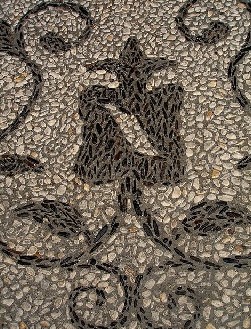
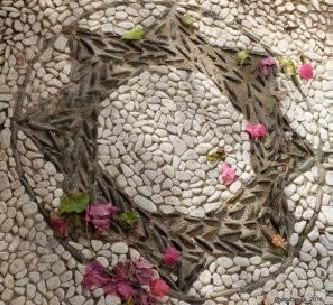
In the gardens and inner courtyards, the pathways were paved with stones, pebbles, or river rocks, creating wonderful designs with incredible patterns.
There is a gigantic artistic creation that uses sizes, colors, and shapes of stones, arranged in geometric figures inspired by nature, along the paths inside the palace.
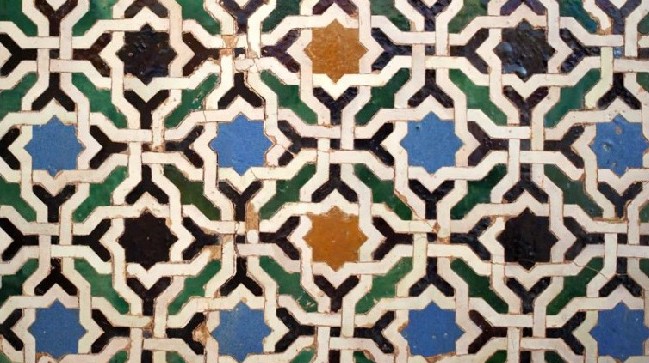
Years later, with some time available, I immersed myself in learning about the world of mosaic. I learned techniques that offered countless possibilities for creativity, using a great variety of materials available today.
Each new work I create reminds me of the entire process humanity has lived through.
Every gesture, every design—whether simple or complex—every different material, every technique of cutting, gluing, and grouting allows me today to create new works that are always rooted in the trajectory of the past.
Each gesture and each discovery already made opens new possibilities and defines the infinite historical network that supports my work.
Each new piece is contemplated with care and respect, because it reflects my current understanding and skills, and may become part of the life of someone who feels inspired by it.
At the same time, just as I build upon knowledge developed so far, I know there are countless other creations made by different people who currently use the same technique.
While writing this essay, I recalled the sense of discovery and ecstasy that accompanied my gaze at every step during my walk through the Alhambra Palace.
Today, on the internet, I had to search extensively to find images and photos of the pebble-made paths.
This is understandable, given the grandeur of the architecture and landscape of the place.
With curiosity, I found a record that gives us an idea of how they were built.
Day after day, unknown workers, sitting on the ground, followed complex and delicate geometric patterns, fitting each small stone into place, covering long paths.
The different expressions of art often challenge our understanding of the world and can awaken in us states of joy, lightness, or also sadness and pain. They often bring the everyday into a new perspective and invite us to go beyond what has materialized.
Today, with my working conditions so different from those of the workers long ago who sat on the ground, I find myself in deep reflection.
From the comfort of a chair and a table, I plan and develop ideas. I use colors and sizes, tools and materials produced by others.
For this reason, I cannot help but revere each step I take, each tool or material I use. They are the result of the effort of every being who, at some moment and in some way, created something.
Moreover, art is only one form of materialization.
Each small piece of tile or stone that is placed begins to shape the idea, creating a network of designs and giving new meaning to that surface.
Each isolated piece has no meaning, but together they create the design and convey the idea that once existed only within me.
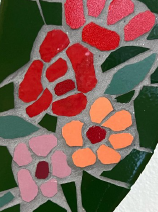
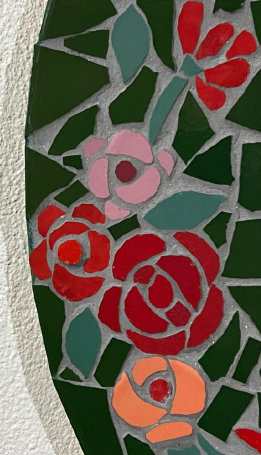
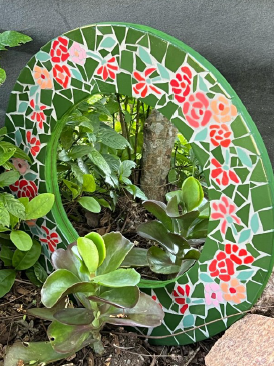
When I see an image or design that inspires me to create a mosaic, I need to make decisions.
What surface will I work on: stone, metal, wood, or glass? What type of materials will I use: tiles, glass tesserae, stones, ceramic fragments? I define the colors and only then begin to work.
The project definitions are essential so that, when I begin, I can place my mind in a state like meditation.
Something similar happens when we tend a garden, and the plants somehow tell us what they need, what we should do. It is an openness that allows the materials to indicate where and how they want to be placed, creating the harmony necessary for the whole project.
Defining the figure still requires a degree of decision-making; placing the background colors creates a kind of game: I observe the pieces and look for where to fit them. This part of the work is true mental hygiene, allowing me to spend hours working, so absorbed that I do not feel the passage of time.
When I finish, I still have one final decision: the application of grout, which will give the work a sense of completeness.
This is a very important stage, because the color of the grout can give the piece the final touch it needs, harmoniously uniting the set of colors and shapes—or it can leave it dull and without expression.
These reflections led me to make an analogy with what I understand as spiritual life in Cafh.
Cafh gives its members a Method of life, an art of living, if you will. It leads us to look with wonder at what surrounds us. We are faced with countless possibilities.
Perhaps life places us in a situation where we must sit on the ground and carefully choose the stones we will place in our work—and probably no one will know who made it.
Perhaps life places us before a large wall where our task is to glue small fragments of color that will only make sense when the work is completed and viewed from a distance. Or perhaps we may conceive projects in the comfort of a chair and a good worktable that never make it beyond the paper.
Awareness of our possibilities guides us to look at the world and current reality as a challenge. In facing it, we can use the tools we have built over time through meditation, reflection, and the awareness that we are part of something transcendent.
We feel the Divine in our own hearts, and we allow it to manifest and materialize through increasingly conscious choices.
There, before the unknown Divine, I recognize that my vision is sometimes partial and sometimes whole, like a mosaic, and is anchored in a Divine Project of which I feel a part and in which I trust with deep reverence.